Flower Essences and Grief in Horses

Years ago I had heard of Rescue Remedy and the Bach Flower Essences.  I had never had a reason to use them or investigate them further, until I had horses.  A holistic vet told me that flower essences can be useful with emotional issues in animals.  At the time they were completely outside my experience, and a little too “woo-woo” for me.  Emotional issues and animals?  Well, okay, but I kept the idea on my back burner for future reference.  When it came to the well-being of my horses I would consider it when the time arose.

When my horse’s pasture mate died of colic, that time came up.  My horse’s demeanor was visibly different for days.  He just stood in the corner of the field away from the other horses with a low head and sad look in his eyes.  He looked depressed, and there really wasn’t anything I could do to fix the situation and bring his horse friend back.  Then I remembered, “Flower essences!”  Maybe they could help.

I pulled out my animal wellness collection of 23 different blends of flower essences.  (Yes, they were a little woo-woo, but if my horse indicated he wanted them then who was I to argue)?  I chose a couple of different blends like “grief and loss” and “transitions”.  I put them in my pocket, and then went out to see my horse.

Without me looking at the labels, I let him sniff each one.  On some he turned his head away.  I took that as a “no”.  On others he tried to nip them out of my hands.  “Okay,” I thought, “I guess you want those.”  I placed a single drop on my fingertips and touched the tips of his ears with it.  Then he did something he’s never done before, or since:  He licked it off my fingertips.

Twice that week he wanted the flower essences I offered.  Then on the third day, he no longer wanted them.

While I don’t fully understand flower essences, I do trust my horse’s instincts, and I’m more than happy to let him tell me what he wants.  The bonus for me is that I get a little glimpse into his world of being a horse, and I come to understand him that much more.

The Power of Touch

A few years before I owned my first horse, I came to know him at a therapeutic riding facility.  Over several years his pain level seemed to be increasing.  A colleague and I decided to see if we could find a properly fitting saddle for him, and perhaps that would resolve his pain issues.  I remember gently touching his back on both sides of his spine, looking for where he would pin his ears.  That is where he hurt.  His shoulders were uneven and western saddles tended to pinch them.  He made it clear he did not like being touched on his shoulders.  If I touched his shoulders, he pinned his ears.  By the end of the afternoon we found an English saddle that seemed to steer clear of his shoulder pain.

Every time I exercised him I first checked his back for pain.  I watched his eyes and ears for communication from him as I slowly ran my fingers along his back.  As I did this routine more and more, I began to see another pattern developing.  There were places I touched where he would relax and close his eyes.  Fascinated by this response I was soon looking for the places where he wanted to be touched, rather than the places that caused him pain.

After a few months of this new discovery, I started experimenting with my own thoughts as I touched him.  One afternoon I put my hands on him, and in my head I expressed my appreciation of him.  As I consciously said in my head how much I appreciated him, he relaxed and closed his eyes right in time with my thought.  I knew horses could read people inside and out, but this was the first time I experienced a purposeful thought in my head and his corresponding response, all in silence.  Fascinated again, I spent many afternoons just experimenting with positive thoughts in my head and observing his response.

Several years later, I came upon a type of body work for horses that is similar to massage called the Masterson Method, where the horse directs the human on where and how to touch.  I realized I had learned many of the basic Masterson Method techniques by accident from my horse.  Not only does this type of body work help the horse physically, it also increases the bond between horse and human.

For more information, check out www.MastersonMethod.com.

SANYO DIGITAL CAMERA
My first horse getting one of his many massages.

In the photo above, notice that his ears are slightly back, which means I don’t have quite the right touch or place he wants my hands.  I can try many things in my own body to change this:  breathe, change the thoughts in my head, decrease the level of touch, or move a few millimeters to a new location.  His ears will tell me when I get it right.  Try it with your own horse.  The horse will let you know when you’ve found the spot.

Notice his ears in this photo.  My sister gets it just right.
Notice his ears in this photo. My sister gets it just right.

Diarrhea in Senior Horses

The second senior horse I took in was a 27 year­-old palomino gelding named Thunder.  He had chronic diarrhea for years.  While with the previous owner, the vet could not find a cause.  They started him on a probiotic, which seemed to help.  They even tried worming him with Moxidectin, which is the most potent of all wormers.  (You do not want to get the dosage wrong, and it is not typically recommended for senior horses).  They thought that perhaps the cause of the diarrhea was a worm that only Moxidectin could kill.

The year or two before I took him, I heard that he was having problems with diarrhea.  I did some research and learned that if you have a senior horse with diarrhea the first thing to eliminate as a cause is the teeth.  An equine dentist, who has extensive training beyond vet school can give a complete evaluation of the mouth and teeth.  An equine dentist will catch things a general equine vet may not.

When I took Thunder into my care the first thing I did was take him to the dentist.  The dentist said his teeth were completely worn out and could no longer chew hay.  The molars in horses should be completely flat and when the top arcade of molars meets the bottom arcade it grinds hay.  Thunder’s teeth were “cupped out”, meaning there was no longer a flat surface, but rather a cupped surface.  When he went to grind hay he couldn’t.  The dentist said that if large pieces of inadequately chewed hay were to get all the way to the colon, they could irritate it and cause diarrhea.  It looked like that was what was happening with Thunder.

I immediately took Thunder off hay and fed him soaked hay pellets.  Within a week his manure normalized, and there was no sign of diarrhea.  I even weaned him off the probiotic, and the diarrhea hasn’t been back. It’s been 2 1⁄2 years.

I asked the dentist if the present condition of Thunder’s teeth was preventable.

“Yes,” he answered.

“When would have been the last chance to start seeing him before we would end up with worn out teeth?”

“Ten years ago.”

Why does this all matter?  It’s cheaper to feed high quality hay than it is to feed hay pellets.  It’s more convenient to feed hay than it is to soak hay pellets a few times a day.  While I don’t regret a single moment figuring out what Thunder needed and then providing it, if different decisions were made 10 years ago, and the information was in the hands of the horse owner, then Thunder could have been spared the years of chronic diarrhea and the resulting toll it took on his body.

If you have a horse, consider seeing an equine dentist as part of your horse’s care team.  Don’t wait until they are old and having serious issues.  Prevention is key.  The health and longevity of your horse depends on it.  And the best part of all, you will have more years to enjoy your horse.

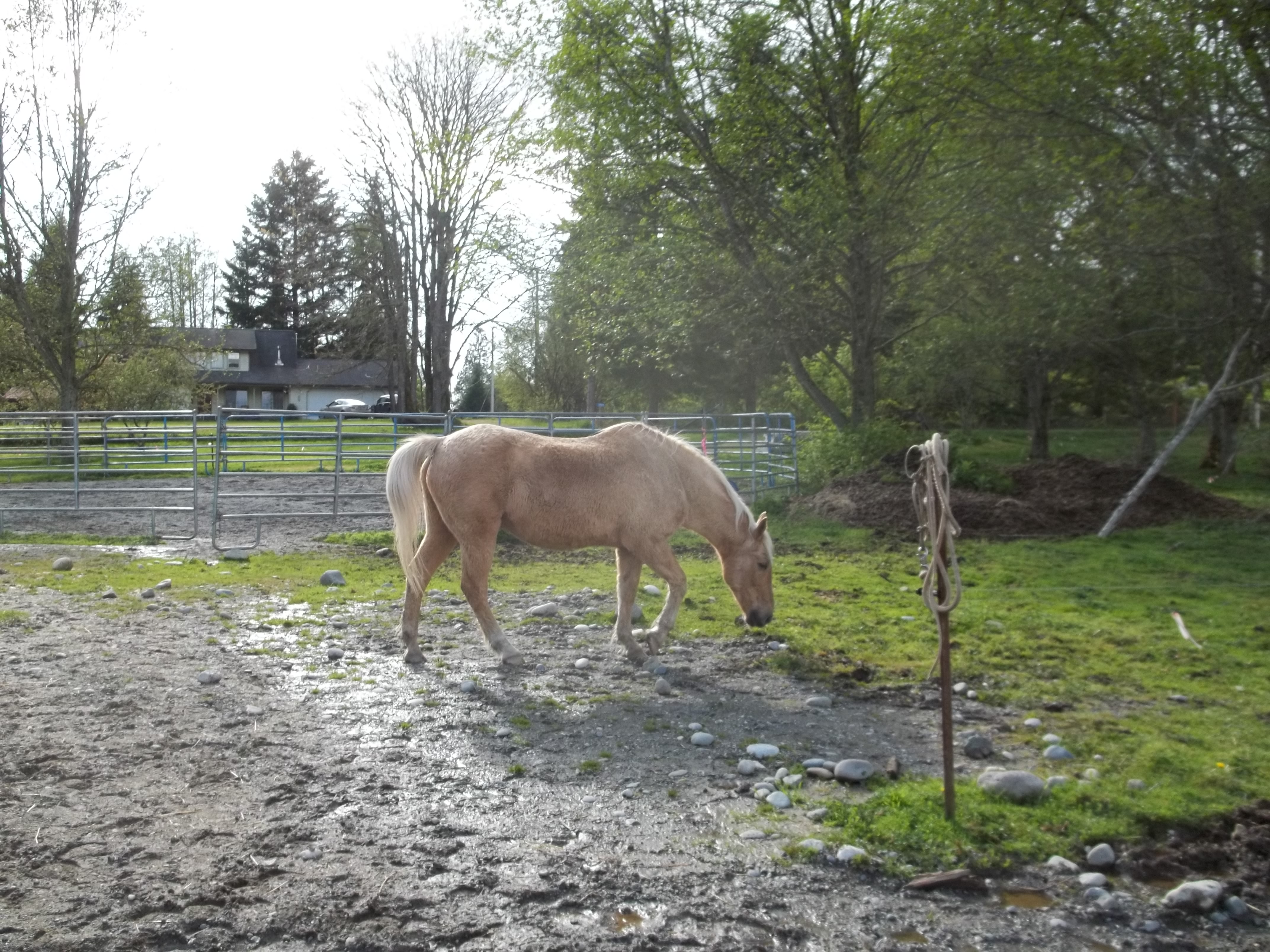
The day I picked up Thunder.  Notice the dirty hocks.  It is from the chronic diarrhea.
The day I picked up Thunder. Notice his dirty hocks from the chronic diarrhea.

100_0072

100_0209
6 days post diet change. Normal manure.
100_0232
20 days post diet change. Notice his clean hocks. No more diarrhea.