Can a 2 ½ year-old learn to read the body language a horse? If you had asked me that question a year ago, I would have said I don’t know. Today, however, my answer would be, “Yes. Definitely.”
Recently, my 2 ½ year-old nephew came to visit. He was enamored with shoveling manure and helping fill water buckets for the water trough. When Chaco, my horse, came over to say hello to him, he hid behind his mom. He was very much aware of how tiny he was compared to Chaco’s 1100 lbs. While he hid behind his mom, we all enjoyed each other’s company, leaving the natural boundaries in place. Chaco remained in his place, and let my nephew enjoy the comfort of hiding behind his mom. The last thing I wanted to do was make my nephew over-ride his own personal boundaries and go pet Chaco.
At the end of their few-hour visit, it was time to say good-bye to the horses. I picked my nephew up to make the rounds. He was much more comfortable in my arms around these big horses. We said goodbye to Chaco at his shoulder, and then moved a few feet away to give Chaco more space. Chaco was relaxed, so I spoke to my nephew is a slow, low voice about Chaco’s eyes. Since he had recently learned human vocabulary for body parts, he understood what I meant by the word “eyes”, and began watching Chaco’s eyes with focus.
To my nephew I said, “This is Chaco’s nap time. Night. Night. Do you have night, night at home?”
The more I talked about Chaco’s nap with an increasingly quiet and slow voice, Chaco’s eyes blinked slower and slower. Meanwhile, my nephew was mesmerized by Chaco’s closing eyes. He even leaned forward slightly, intently studying Chaco’s relaxing eyes.
It was so peaceful that I did not want to interrupt the moment. We remained like that for several minutes. I continued to speak slowly and quietly, experimenting myself with how my voice was luring Chaco to sleep.
What a perfect end to the day. I was pleasantly surprised by the focus and curiosity of my 2 ½ year-old nephew. How great is it that at his age he is learning to read the fine nuances of the eyes of a horse? I can’t wait to see what unfolds next in his understanding as he grows up.
In rehabbing senior horses retiring from therapy work with at-risk youth, the horses that come to God’s Window are typically well-trained, docile horses. Often times they just need a break and allowed to be a horse and do horse things 24/7.
I once learned from horse ethologist, Mary Ann Simonds, that in wild horse language, whoever has their eyes in front is the leader. A wild stallion who takes one of his foals on patrol with him, will clearly have his eyes in front and then the baby’s eyes and head are just behind the stallion’s eyes and ears. There is a wonderful photograph by Barbara Wheeler of this body positioning.
As an experiment, I started leading my horses that way to see what would happen. It has made such a positive difference in safely leading my horses that I don’t even remember exactly how I used to lead horses.
The first time I need to lead any horse with a halter and lead rope, I establish this boundary right away. My eyes are in front, and the horse’s eyes are behind me. I begin by taking a few steps and then stopping. Once I stop, I turn around and remain where I stopped and then ask the horse to back two steps away from me. Once they do that, then I turn back around and take a few steps forward. I stop again, and turn around and ask the horse to back up two steps. This is all done in a very low-key way. I keep doing this exercise until the horse starts to stop with its eyes behind my shoulder.
I remember the day my second horse, Thunder, arrived. He was a 27 year-old gelding and a very well trained, docile horse. I hesitated to immediately do too much boundary setting with him right as he walked off the trailer because I didn’t want to impose anything on him. He had just retired and was seeing his new home for the first time.
As we walked down the driveway his ears were perked forward and his head was up surveying the area and the resident herd of three horses. His energy was also up, and he had a forward walk. Since I was just walking with him down the driveway and not asserting any leadership on my part, he led the way and walked in front of me. I ended up being at his shoulder. I let this go on for about half-way down the driveway when I realized that this was not the safest place for me to be. He was clearly in front of me and focused on the resident herd, and not really aware of me.
I am at Thunder’s shoulder, and his eyes are in front of mine, which tells him that he is leading me, which is not the safest place for me to be.
I decided to take back the leadership role and set a few boundaries before anything got further out of hand. I backed him up a few steps until he was behind me. Then I walked forward a few steps, stopped and backed him up again. After about three times of doing this he took a submissive posture behind me. He was still very aware of his surroundings, and he was listening to me as well. I felt much safer, and the rest of the day unfolded without incident.
In the days after Thunder arrived, I took a walk with all three of us: me, Thunder and Chaco, my first horse. I was really black and white with the boundary that both of them needed to be behind me when I led them together on a walk. Walking two horses at the same time had double the capacity for something to go wrong, so the best chance I had of safely walking them together was for both of them to respect the boundaries I needed, which was both of them walking behind me.
Chaco had no problem stopping behind me having seen this routine for years. Thunder, however, was new. Several times he stopped in front of me. I would patiently back him until he was behind me and then go forward again. On one of these corrections to Thunder’s positioning, Chaco stopped at a respectful distance and cocked a hind leg in relaxation taking a standing nap while Thunder learned the ropes.
Chaco knew the routine and didn’t bother testing the boundary. Thunder, however, was new and not familiar with the routine. But it didn’t take long. Within a few walks he was regularly walking behind me. Once that was in place, I felt comfortable asking him to walk ahead of me on occasion or laying the lead rope over his back while he grazed the plants on the trail.
Whether leading two horses or one, the simple boundary of placing the horse behind me when leading has allowed our walks to become a calm and peaceful outing. I feel safe, and the horses feel safe, which builds mutual trust. What a great way to safely enjoy the beautiful surroundings and the company of my horses.
Notice how the first horse has his eyes in front. He is leading. The two following horses both have their eyes behind the horse they are following. This is a submissive posture.
I recently had a photographer friend come out and spend part of a day taking pictures of my horse, Chaco and his herd. Since I keep Chaco in as natural of an environment as possible and let him have his own opinion, even when it differs from mine, I let my friend know what to expect so he could decide if it would work for him taking pictures.
Here were the parameters:
The horses live in a herd on acreage. They come and go as they please. Their resting heart rate is half the rate of ours, so we need to allow double the amount of time that we think we do. If they sense any agenda from us, or a tight time frame, they will feel it and likely respond with less cooperation.
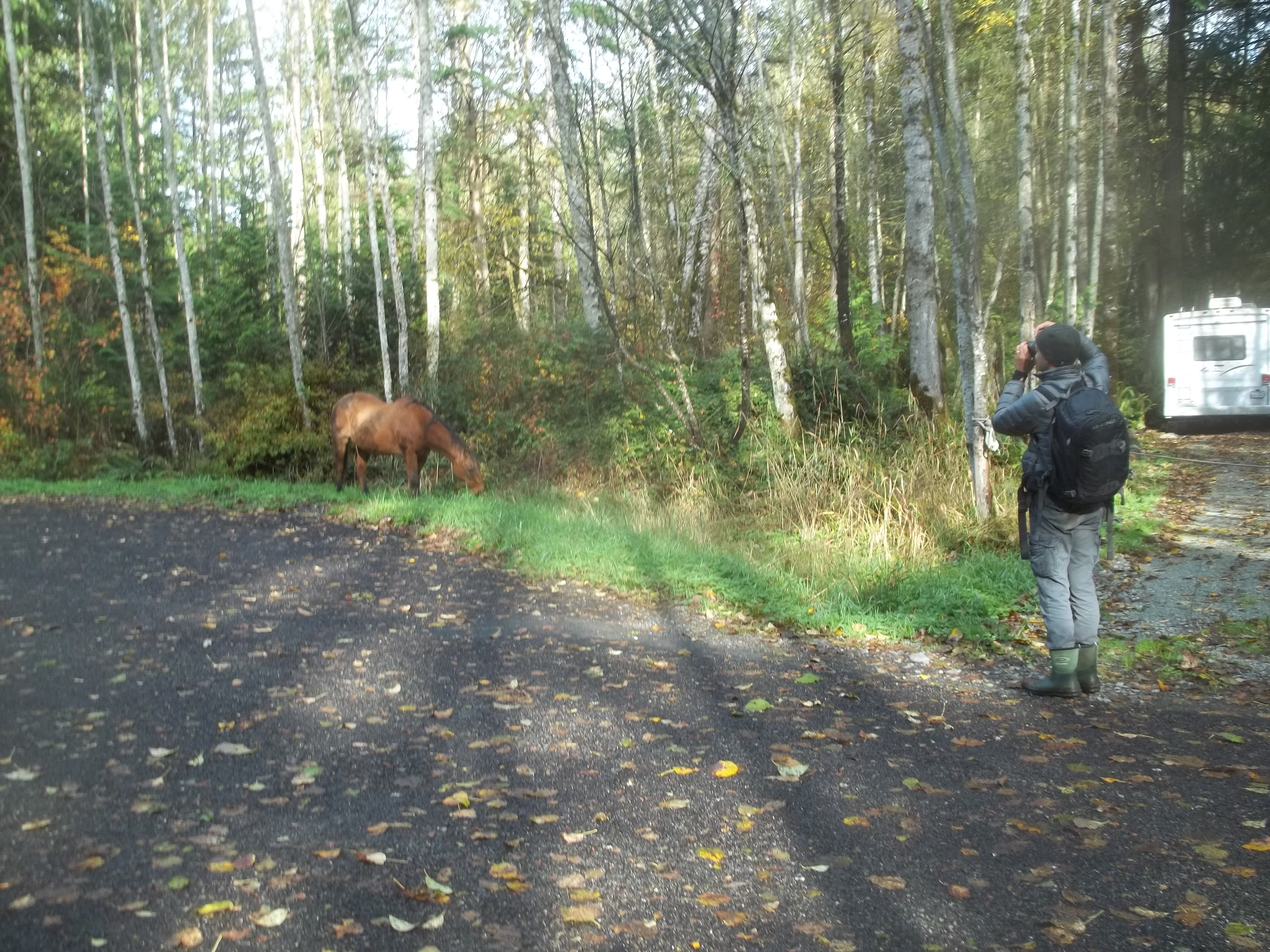
He was fine with that, so one fall foggy morning we met at the field where my horse lives with his herd. We entered the field and walked away from the horses, ignoring them. It’s a great way to give horses space, and let them decide of their own free will if they want to close that space between us and come over and say hello. A human can walk up to a horse, enter its space and say hello, however, that is the human initiating the contact. A fun experiment is to allow the horse to initiate or not initiate the contact.
So we walked the other way, far away. Sure enough, Chaco, the herd leader picked up a very active, forward walk coming in our direction. The kind of forward walk that is treasured in the dressage world. He started following us, and Pearl, the second in command under Chaco, followed suit, right off of Chaco’s hip.
I had never had horses follow me with such determination. He and Pearl weren’t mean or aggressive, but rather, very curious.
It was as if he was asking, “Who is this new person with a large camera and a backpack? And he’s ignoring us. Who does that other than Mary?”
After we walked a few hundred feet, we stopped and looked back from where we had come. Chaco and Pearl were still hot on our trail with their very active walk. But the walk was not a straight line toward us, but rather a meandering line. We decided to keep moving. Here we were on several acres trying to get away from these very curious horses.
Chaco did not give up his curiosity.
Finally, I said, “O.K., Let’s stop. I think he wants to check us out. Let’s let him say hello.”
We stopped and Chaco came straight up to me and my photographer friend. This was a two-eye approach for Chaco. When a horse gives you both their eyes, you know you have their complete attention.
Chaco was particularly curious about my friend. He breathed on him (horses breathe into each others nostrils as a greeting, and they have an incredible sense of smell, well beyond our capabilities). He also checked out the camera. Chaco was right there in our space. It was natural for my friend to pet him on the neck. After several moments, Chaco decided everything checked out o.k., so he turned and left to graze about 20 feet away.
Just as quickly as Chaco decided he really needed to meet my friend, he just as quickly went to grazing as soon as the meeting occurred.
As we watched Chaco graze just a few horse-lengths away, my friend commented, “Wow. After all that (being intently followed), it’s suddenly over and no big deal.”
The next several hours my photographer friend and I walked the field and the trails, taking photos of Chaco and the other horses. Chaco was agreeable to all of it. Once we passed his initial inspection we had his approval for being in his home.
I think our biggest fear as humans is that if we allow a horse to have an opinion and act of their own free will, they will NOT want to be with us. That is a legitimate fear. On the flip side of that fear is a connection with horses that is beyond our wildest dreams. When they connect with you of their own free will, it is one of the most amazing experiences because it can’t be forced, nor scripted. It’s really them wanting to communicate with you.
Over the years of experimenting with this idea, I have found that horses are curious animals that when allowed to express their opinions of both a “yes” and a “no”, there is a third option that starts to appear that’s not about yes and no, but rather about wanting to connect with you, wanting your help with something, or wanting to just be in your presence. It is then that you see who they are, and how they want to interact with you. And it’s the real you they’re interested in, not the you that has a million things to get done.
I think horses are just as curious about us as we are about them. Allow them the space to be themselves and prepare to be blown away by what they have to say about being with you. It will change your life. I know it has changed mine.
Several years ago I took my horse, Chaco, and his pasture mate, Barley, on a summer vacation to the hills of eastern Washington. A friend of mine had 75 acres, and the back 45 acres of sage brush hillside were Chaco’s and Barley’s home for two weeks. The climate was dry and hot; the dirt was like powder. The horses loved it.
To get to this back 45 acres, we had to pass through a several acre field where my friend kept her herd of 10 horses. I knew many of her horses well, and especially the herd leader. Other than Chaco, he was one of the fairest horse leaders I have ever known.
He could set a pace and lead you out of the mountains and get you back to the truck and trailer by dark. He was a wonderful protector of his herd. If someone unsavory ever came on the property, he didn’t take his eyes off them until they left. While he had boundaries and wasn’t afraid express them, he didn’t waste energy on unnecessary things. I never saw him be overly aggressive. The best way to describe him was he was fair and of sound mind.
One evening after I fed Chaco his special food down by the house, I walked him and Barley up to their 45-acre home in the dark. There was just enough light from the moon and stars for me to be able to see. Horses have spectacular night vision, so walking in the dark was quite comfortable for Chaco and Barley.
To get to where we were going, we had to walk up this canyon-like corridor that opened to the field where the herd of 10 horses lived. Then we would have to walk through that herd’s home to get to the 45-acre hillside where Chaco and Barley would go.
As we walked, I kept Chaco and Barley behind me so it was clear to them that I was leading this little herd of three: me, Chaco and Barley. Barley always deferred to Chaco, and Chaco would defer to me, so if and when we came upon the herd of 10 horses, I would be the one calling the shots. The last thing I wanted was Chaco and Barley thinking they needed to negotiate or defend themselves when we reached the 10 horses. That would be dangerous for me.
As we walked up the corridor, the sky was midnight black and speckled with so many stars I had difficulty recognizing any constellations. It was breathtaking and peaceful. We were about 2/3 of the way up the corridor when I heard a set of hooves come thundering toward us. I stopped and made sure Chaco and Barley were behind me. I stood tall with open, relaxed, square shoulders to communicate to this approaching horse to stop at a distance from us.
Sure enough, the herd leader came into focus, his white/gray coat easily seen in the dark. Once he saw us, he slowed to a walk and stopped about 25 feet away, his head up, ears pricked forward and both eyes on us.
I was quite happy that he stopped where he did. A horse’s personal space is about 10-15 feet out from its body in all directions. 12 feet out from me and my herd, and 12 feet out from him are 24 feet and right about where he stopped. There was no need to do anything because we had both just acknowledged each other’s presence at a safe distance. He was respecting my space, and I was respecting his space.
I really wasn’t sure what was going to happen next, but it didn’t matter. We had mutual acknowledgement and respect, and neither of us had a need to make the other do anything.
In my mind I’m thinking, “Hey, it’s just us. Sorry to alarm you. We’re just walking up to the 45-acre hillside to drop off Chaco and Barley.”
We had reached the edge of his territory, and as protector of his herd, he wanted to know who we were. Out of respect for him and his home and herd, I didn’t move, but I also did not give up any of my ground. We were both square to each other, and we were both looking at each other with both eyes. (Both eyes in horse language mean complete attention).
Neither of us moved, and yet we were both very much aware. A move forward by either us at that point would be considered an aggressive move. A retreat by either of us at that point would be a submissive move. Both of us stood in the neutral place of being neither aggressive, nor submissive. It was the meeting of two leaders, both respectful of the other, and both aware of their responsibility to their respective herds, and both not wanting any trouble.
That moment lasted several moments. I could have stayed there forever: the diamond stars glittering in the night sky, this powerful gray horse meeting us at the gate to his field, fulfilling his duty as protector of his herd, and Chaco and Barley waiting respectfully behind me.
For me, it’s moments like these that I treasure most about interacting with horses. I have found that if I am patient and willing to wait long enough, horses will make their own decisions. It’s fascinating to me to find out what those decisions are.
So on this beautiful evening, in the presence of all these horses, I waited to see what would happen. After thoroughly checking us out from a distance, the big gray decided we were not a threat. He stepped aside to let us pass through his home. I was honored.
In order to be as unobtrusive as possible, we found a path around the herd of 10 horses and headed for the far gate to the 45-acres hillside. The resident herd was curious and began following us with a relaxed posture. I did not want any problems, so I did not allow any of them to get too close to us. We crossed their home without incident.
Two weeks later, on our last day there, I walked up to the 45-acre hillside to catch Chaco and Barley to lead them across the resident herd’s field for the last time. I had grown to like that twice daily walk that took about 30 minutes round trip. The crunch of dry grass and soft dirt under my feet had begun to feel like home.
Near the gate to the 45-acre hillside, the leader and his herd had congregated. They had never been at that gate before, but on this day they were there. I sensed that they knew we were leaving for the last time.
I spent a long moment just hanging out and being with them, breathing, relaxing and enjoying their company and the beautiful place in which they lived. I thanked them, the herd leader in particular, for sharing their home with us for the past two weeks. It all began with him allowing us to traverse his territory without incident that first night.
With a heart full of appreciation for him and his herd, I reluctantly said goodbye. It was a bittersweet moment as I gathered up Chaco and Barley, and we walked through the resident herd’s home for the final time.
I savored every step down that hillside and the 360 degree panoramic view before me: sparkling blue sky, a few token billowing clouds, the river valley below us, and the mountains framing the land. This time, the horses watched us go. As we neared our exit, I looked back one last time, took it all in, then dipped out of sight.
Chaco following the resident herd leader on the trail.Preparing to leave on our last day.
Having spent years around horses, and the past 10 years rehabbing senior horses, I hear people talk about listening to your horse. Since horses rarely use their vocal chords for communication, and we humans use a lot of verbal communication, just how then do we listen to a horse?
I recently went to take my horse, Chaco, for a walk. He was finishing eating his hay while I went and found his halter. As I approached, he turned and walked off.
“Okay,” I thought.
Rather than take offense that he left, or think that there was something about me he didn’t like, or think that I needed to correct disrespectful behavior, I just stood there without judgment and watched what was unfolding before me.
He walked down the fence line to the back of the paddock over by the manure pile. There was a gate back there to the field.
“Did he want to go out?” I wondered.
As I watched him, I did nothing. I just observed, curious to know what he was up to. He knew I had a halter in hand, and he clearly left when I came for him to go on a walk. I wondered what he was saying.
I could go after him, use my body language to stop him from walking off and put the halter on him. If I insisted I knew he would acquiesce. But I didn’t want acquiescence. I wanted to know what he was thinking.
So I just stood there, not moving an inch and observed, knowing that if I waited long enough, his intentions would become clear to me.
He meandered around the back of the paddock, found the perfect angle to plant his body and then lifted his tail. Within 10 feet of the manure pile, he passed his own pile of manure.
“Oh, that’s what you wanted to do,” I thought to myself.
But I knew his communication wasn’t over yet, so I stayed right where I was curious to see what he would do next.
“Would he come back to me to go on the walk?” I wondered.
There was no guarantee, but that was the beauty of it. It was in Chaco’s hands, not mine, and this is where I would get to see what Chaco really thought. Knowing what he thought was more important to me than the walk.
Sure enough, he meandered back my way with soft eyes and a low head. He was the picture of relaxation. He stopped about 10 feet away from me with both eyes looking at me.
This was significant to me because when a horse gives both their eyes to whatever they are looking at, they are giving it their full attention. If their eyes and head are in a relaxed position when they do this, it is a big green light.
10-15 feet is also a horse’s sense of personal space, so him stopping about 10 feet from me was like a friend walking up to me and stopping at arm’s length, which is a human’s sense of personal space.
He also just so happened to stop next to the gate that opened out to the driveway and the route we typically take on our walks.
In human terms, all of these cues told me that he just wanted to run to the bathroom before we left for our walk.
At this point, I approached him at his shoulder. He didn’t budge and his eyes and head remained relaxed. I held out the halter for him, and he put his head into it. That action sealed the deal for me. Yes, he wanted to go.
How do I know for sure he really wanted to go? There have been times when he has said “no” by not putting his head in the halter himself. There have been times when he has said “no” by walking off and leaving completely and not returning. In those cases, we don’t go for a walk. By honoring his “no”, and him knowing I will honor his “no”, he is then free to say yes.
(Have you ever known a person who always said “yes” to you? They’ve never said “no” to you. Can you really trust their “yes” actually means “yes”? Without a healthy “no”, a true “yes” doesn’t exist).
Listening to a horse takes time, sometimes a lot more time than we humans might like or allow. Their resting heart rate is half the speed of ours, and when they are relaxed, they really don’t move that fast. But if you want a calm, trustworthy horse, slowing down and matching their pace will do wonders for being able to listen to them.
The slower I go, the more I am able to listen and pick up the fine nuances horses are communicating all the time. In fact, I go so slow that I end up spending considerable time seemingly doing “nothing”. The irony is that in that “nothing” there is a whole lot of listening going on, and ultimately, two-way communication.
The more I practice listening to Chaco, the more the mystery of who he is unfolds before me. I can’t get enough of it. I just love hearing what he has to say.
On this Thanksgiving, when you listen to your horse, what does he or she have to say to you?
Rehabbing retired senior horses can easily become a full-time job. Being such large animals, the average horse weighs 1000 – 1200 lbs., and needs a lot of space. They eat 20 lbs. of hay per day and pass 10 manure piles per day. Everything about them is on a large scale.
When a horse reaches maturity, they are incredibly powerful animals. It’s no accident that they talk about “horse power” in a car. Over the centuries they have done many jobs for humans, from farming and transportation to war. Today they’re even being used to help humans in emotional and physical therapy.
They are so versatile, and can do so many things for us. Because of that, one important question is easy to overlook: Who are they?
I recall a story of a woman who had been involved with horses for 30 years, riding different disciplines. Not until she took in a “grumpy” retired service horse did she realize she did not know what to do to help him. He was always unhappy, pinning his ears. Desperate to find a solution to his unhappiness, she stepped outside her box of 30 years and found a body work practitioner who had a different skill set.
After this horse’s body work session she learned some techniques to do with him to help him feel better in his body. Over time, this horse’s demeanor completely changed. His happiness returned. He no longer pinned his ears.
The experience changed her life. She said that in all of her 30 years of experience with horses, she never knew them, until now. A door had been opened into the world from the horse’s point of view.
With everything horses do for us, whether riding or therapy work, it’s easy to forget that they are sentient beings who have their own horse life that is different than ours.
The next time you see your horse, take a moment and pause in the midst of everything you need to do and just be. Experiment with a few minutes of doing nothing and just being in the presence of your horse. I’d love to hear what you learn.
I never tire of seeing worn out and oftentimes, shut-down, senior horses come back into full health on all levels: physical, mental and emotional. What I have found is that when their needs are met in these three areas, I begin to see for the first time what a truly alive horse looks like.
What’s even more fascinating to me is what happens next. Their individual personalities come out into full expression. Being on the receiving end of a horse that wants to communicate with you of their own volition, is an incredible experience. It is then that I see who they are, and who God created them to be. Every time I experience that, it is so awe-inspiring, it is beyond words.
I think it’s the same in humans. We want to be seen and to be heard. When that happens the possibilities are endless, and the full expression of what it means to be alive comes forth.
Now, I’m curious. What would happen if we approached the world like that?
If a horse pins its ears, that is, lays them back against its head, what is the first thought that comes to your mind? Is he angry? Grumpy? Annoyed? Feels crowded?
While we may make judgments about what we think the horse is saying, the fact is, we really don’t know for sure, and we don’t know why he’s saying whatever it is he’s saying. Solving this communication mystery, without judging the horse, will open doors to a whole new world.
I recently did a horse camp for my 8 year-old niece, and before she got on to ride, I asked Chaco, my horse, to circle me at the walk a few laps each direction. He was responsive, so then I asked for the trot. The moment he picked up the trot he laid his ears back, and they stayed back.
I stopped and walked over to my niece and asked, “What happened to his ears when I asked for the trot?”
“They went back?” she asked.
“Yes, they did. What does that mean?”
“He’s unhappy?”
“That could be. Something isn’t right, and he’s letting us know. The mystery is we don’t know what it is. The only way to find out is to try different things until his ears don’t go back anymore. He could just be stiff, and maybe after a few more circles of trot he’ll loosen up and his ears will go back to a forward position. Let’s see what happens.”
I sent him again a few laps each way, stopped and then walked over to my niece.
“What did you see?”
“His ears were still back.”
“What do you think he’s trying to tell us?”
With a quizzical look on her face and thinking really hard as to what it could be, she said hesitantly, “It’s too fast.”
“That’s a great idea. Let’s try having him walk out and see what happens.”
So I sent Chaco in a forward walk a few laps each way, and then stopped and went back to my niece.
“What did you see?”
“He liked it. His ears were forward.”
“Congratulations! You figured out what Chaco was trying to communicate to you. His trust in you to listen to him just went up.”
With Chaco being 33 years old it was completely reasonable that the trot on that small of a circle was uncomfortable for him.
The rest of the day went so well that when she went to leave, Chaco was so relaxed that he ignored his hay and kept both eyes on her. She probably spent at least 15 minutes saying good-bye and giving one more hug several times, and he welcomed them all. It was confirmation for me that she read him correctly when she stuck with the walk.
Because horses spend so little time talking with their vocal chords, it’s imperative to learn to read their primary mode of communication: body language. It’s a silent language, but so powerful. As you start to get the hang of it, a whole new world opens up.
My seven year-old niece visited recently and really wanted to take my horse, Chaco, for a walk. After finishing the barn chores, we took a grooming bucket and halter out into the field and went looking for Chaco. We found him taking a nap enjoying the dry afternoon of no rain.
He was caked in dried mud from the day before, and we began the process of brushing all of it off of him. Yes, we could just halter him and take him for the walk, but the day was dry. His hair was dry, and the mud was dry enough to brush it out. Since it could rain at any moment, we decided to go with brushing him out first.
There was so much dried mud that plooms of dust encircled him as we brushed. You had to keep your mouth shut, lest a mouthful of grit and dirt got in. Soon we cleaned him up, and he was still enjoying his quiet time napping.
I showed my niece how to gently place the palm of her hand on his coat and just breathe and relax. As she did this, I instructed her to watch his eyes. If they blinked or started to close, then he liked how and where she was touching him. If they stayed wide open, then he didn’t like it. In that case, I told her to lighten her touch, or move her hand over a millimeter or just breathe and relax more herself.
This became an ongoing dance with Chaco. At times, he closed his eyes completely. Other times he held his eyes open. At one point we decided to give him some space, so we stepped away from him.
She then asked, “Can we take him for the walk?”
I responded, “Yes, we could, however, when you look at Chaco right now, what is he really enjoying?”
“His nap,” she acquiesced.
I explained further, “With horses, you may come with a plan to do a particular thing, but if they present a different opportunity to you, then I’d take what they offer. You never know when that offer will come again.”
Despite really wanting to go on the walk, my niece understood, but was disappointed.
Seeing how I might be able to cheer her up, I asked, “Have you ever kissed a horse at the base of their ear? It is the most heavenly spot.”
She never had, so I picked her up and stood a few feet away from Chaco in front of him off to one side. As I held her, and before we approached, I explained the details of being around the head of a horse, where it could move suddenly, and how to keep herself safe, if he were to move.
No sooner had I finished the safety talk, that Chaco lifted his head up out of his nap and stretched his neck out toward us, putting his whiskers and muzzle ever so gently against her cheek and breathing on her. His eyes were soft, and he was curious about who this little girl was, checking her out and taking her all in. We stayed there, not moving an inch, and just savoring this gift Chaco was imparting to her.
When Chaco was done my niece said, “He gave me horse kisses.”
“Have you ever experienced that before?” I asked.
“No,” she replied.
“If you had to pick between horse kisses and a walk, which one would you pick?”
Without hesitation, she said, “Horse kisses.”
“Aren’t you glad we didn’t go for the walk earlier?”
“Yes.”
“It is because we honored his nap and went along with what he was already doing, that the opportunity came for him to give you the gift of horse kisses.”
Those horse kisses became the highlight of her visit. To be fully acknowledged and accepted by a 1000 lb. animal just out of their own curiosity is a magical experience. It is what keeps me coming back to them. It’s why I shovel manure in the rain, why I get up early to feed them, and why I spend hours researching how to improve their health.
You never know when the magic will happen, but if you spend time just being with them with no agenda or expectations, they will surprise you over and over. That is the world they live in, and when I get a glimpse of it, it makes the commitment to them all worthwhile.
Here at God’s Window, we keep our horses in a herd on acreage year-round. They come and go as they please. The more natural their living environment, the healthier they are. Having space to move day and night, and the companionship of other horses is vital to them thriving.
Living in a herd 24/7.
When I go out into the field to visit, it’s not uncommon for them to come over to me. It usually starts with Thunder. He sees me from afar and looks right at me. I head in his direction, and then walk right past him just to confirm if he really wants to be with me. I find a tree to sit under, and he inevitably comes over and puts his hips in my hands. He wants to be scratched.
After several minutes the rest of the herd begins to meander our way. Chaco, the herd leader, picks up a walk with his head low, ears forward, and soft eyes, (a submissive posture), coming straight for me. I know he wants me to put my hands on him, but my hands are already full with Thunder. If he keeps coming, Thunder will move away out of respect, so I square up my shoulders to Chaco to stop him in his tracks about 20 feet away. He defers to my request, but I know he wants me to leave Thunder and come over to him. After a few minutes of scratching Thunder, I give Thunder some final pats before heading to Chaco who has been waiting patiently.
In this scenario there’s no ear pinning, tail swishing, eye glaring, nor a high head, all of which are stress signals. Instead, eyes are soft, ears are forward, tails are quiet and heads are low. This is the body language of a horse at ease in its environment, and in this case, the environment includes a person.
How often do you see horses giving stress signals in their interaction with people? How often do you see the opposite, horses so comfortable in their environment that they want to interact with people? Horses and people are living, dynamic creatures and stress here and there is a part of being alive. However, how can we cultivate a relaxed state in ourselves and in our horses?